Page 1 of 2
Dynamic analysis doesn't run
Posted: Tue Jun 07, 2022 8:35 am
by Fabiola
Hi STKO team,
I'm new to STKO and I'm trying to model a deposit of 7 layers of soil with different properties and weight.
I built the geometry of the 2D model importing it from an AutoCAD drawing. Then I drew construction lines to get the quadrilateral mesh and I did the merge operation on the entire geometry.
I ran successfully the gravity analysis and now I'm trying to run the dynamic one adding ASDabsorbing Boundaries(2Dauto). I used as imput motion a Ricker Wavelet.
STKO doesn't run the analysis and shows the error window below:
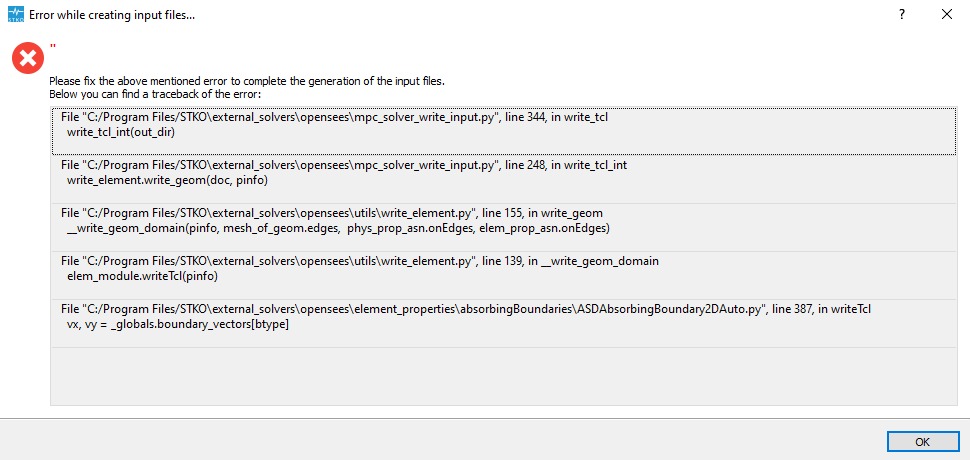
- Error window.jpeg (86.59 KiB) Viewed 4561 times
I don't understand how to solve it. I attached the files of the whole model so you can understand what I've done. Can you help me realize what's wrong?
Therefore I'm in doubt about the necessity of extending the sides of the geometry in order to avoid the reflection of incoming waves. Are the ASDAbsorbingBoundaries2Dauto an alternative to the extension or it is still convenient to do it?
Wait for your reply.
Thank you for your time and help.
Re: Dynamic analysis doesn't run
Posted: Wed Jun 08, 2022 8:31 am
by STKO Team
The drawing you did in AutoCAD is not precise.
For example, the left vertical side is not strictly vertical, you can see it by zooming, or by doing a query of the bottom and top vertex position:

- precision_error.png (47.41 KiB) Viewed 4540 times
The Automatic absorbing boundary assumes the sides to be perfectly horizontal or vertical.
Re: Dynamic analysis doesn't run
Posted: Thu Jun 09, 2022 9:34 am
by Fabiola
Thank you for your prompt reply and the assistance in solving the analysis problem. I fix the problem and it is working fine.
What about the matter of expansion of geometry mentioned above?
Re: Dynamic analysis doesn't run
Posted: Mon Jun 13, 2022 7:49 am
by STKO Team
The absorbing boundaries should be able to absorb outgoing waves. Of course, how far you should place your boundaries depends on your problem. Looking at your model it seems reasonable what you did.
Re: Dynamic analysis doesn't run
Posted: Fri Jul 15, 2022 9:22 am
by MartinaF.
Hi again,
I'm Martina and I'm working together with Fabiola in this project. We are modeling a 2D site response of a multilayered deposit, as mentioned above. In order to model the degradation of soil’s secant shear modulus with the change of shear strain we used the PIMY (PressureIndependMultiYield) material.
We have experimental G/Gmax curve for every soil type so we added that in the $r, $Gs section.
Should shear deformation data be entered in %?
Secondly, we have some issues with damping modeling.
It has been said in other posts that this material inherently accounts for damping so you should not add additional damping to the model. We have some trouble understanding how the material works and how the damping is taken into account.
Many nonlinear soil models to describe the hysteretic behavior for unloading and reloading follow Masing’s rule, is this the case?
If masing rule is adopted, zero damping is implemented at small strain level, where the modulus reduction
curve is linear and it contradicts laboratory test observations. So should we model an additional damping? in which case, should we use a Rayleigh damping for each soil type?
Thank you in advance for your help,
Martina
Re: Dynamic analysis doesn't run
Posted: Fri Jul 15, 2022 5:07 pm
by STKO Team
We have experimental G/Gmax curve for every soil type so we added that in the $r, $Gs section.
Should shear deformation data be entered in %?
This is the description of the user-defined surface type:
you can define yield surfaces directly based on desired shear modulus reduction curve. To do so, provide noYieldSurf pairs of shear strain (γ) and modulus ratio (Gs) values.
The number of columns must be 2 and will be considered up to 39 rows
That is, you can enter a Nx2 matrix, where N is at most = 39. The first column is the strain, the second is the modulus ratio
It has been said in other posts that this material inherently accounts for damping so you should not add additional damping to the model. We have some trouble understanding how the material works and how the damping is taken into account.
No in that sense... In the sense that a non-linear material model already introduces nonlinearity. While rayleigh damping is used to introduce all the non linear behavior that are not physically introduced in the model.
But no material model is so accurate to include every nonlinear effect.
Re: Dynamic analysis doesn't run
Posted: Thu Jul 21, 2022 12:26 pm
by Fabiola
Hello Team,
I'm here asking again for your help. I have some issues with the convergence of the analysis in my model.
I'm using a PIMY material so I set a static analysis (Analysis 1) at first using elastic stage material. Then I updated the plastic stage and set a transient analysis (Analysis 2). I also set an additional analysis after Analysis 2 (Dummy analysis) in order to relax any spurious oscillation. Once this is done, I activated the absorbing boundaries and ran the dynamic analysis, but it shows a very high acceleration. I tried to change the analysis parameters but I couldn't be able to solve the problem.
I attached the file below. Could you please have a look at it?
Thanks in advance for your help and your support again.
Fabiola
Re: Dynamic analysis doesn't run
Posted: Mon Jul 25, 2022 8:56 am
by STKO Team
The post-elastic analyses have a very large error tolerance:
a tolerance of 0.01 in NormDispIncr means that you are accepting an error of 1 centimeter (since you are modeling in meters).
Also, the plastic gravity analysis is made transient with a duration of 1 second. It may induce too large accelerations since the change from elastic to plastic happens suddenly.
I tried to change the parameters but it will take a lot to converge. It looks like all the upper layers in your model entered a deep nonlinear state already from gravity. Here is the last component of the stress tensor which gives an idea of the level of nonlinearity:

- pimy_01.png (92.45 KiB) Viewed 3987 times
This is the strain localization band, which also shows the level of nonlinearity you are having:

- pimy_02.png (77.83 KiB) Viewed 3987 times
Of course, this sudden change from elastic to plastic generates some spurious accelerations. However, as you increase the time of the gravity analysis (I used 100 seconds), the inertia effects will be lower
Here is my file. play with it and let us know:
Re: Dynamic analysis doesn't run
Posted: Tue Aug 02, 2022 10:26 am
by Fabiola
Thanks for your help.
As recommended, i have reduced the tolerance to 1*10-7 and I decided to change the algorithm type (BFGS) because I saw that it takes less time.
For the deep non-linearity I tried to change the alpha (0.6) and beta (0.3025) values in the integration Newmark method. The model works with some tolerance errors on the displacement but i think i can accept it. I attached the file below.
I also have a question, is it possible to get the response and fourier spectrum in the outputs?
Thanks again,
Fabiola
Re: Dynamic analysis doesn't run
Posted: Wed Aug 03, 2022 8:18 am
by STKO Team
The model works with some tolerance errors on the displacement but i think i can accept it.
It's fine because 1.0E-7 in meters is pretty small as an absolute error.
I also have a question, is it possible to get the response and fourier spectrum in the outputs?
Not as a built-in command, but you can use the PythonAPI to post process any response provided by OpenSees.
Have a look at the webinar "Intro to PythonAPI"