Page 1 of 1
About ASDConcrete3D User-defined
Posted: Thu Jul 04, 2024 12:36 pm
by haishui
Hi,STKO team.
I was recently working on a push-over simulation of a reinforced concrete column with an ECC jacket. The ECC jacket was simulated with ASDConcrete3D user-define constitutive. And here are some issues I have met.
1.How does ASDConcrete3D user-defined specifically consider material damage? I carefully read the introduction of the construct on the official website of opensees, but I still can't relate it to the parameters Td and Cd.
2.Can ASDConcrete3D describe the hysteresis performance of ECC solid elements? If not, which constitutive in STKO is more appropriate to simulate the ECC solid element?
sorry for bothering,and Glad to hear from you.
Re: About ASDConcrete3D User-defined
Posted: Wed Jul 10, 2024 8:48 am
by kesavapraba
Hi,
How does ASDConcrete3D user-defined specifically consider material damage? I carefully read the introduction of the construct on the official website of opensees, but I still can't relate it to the parameters Td and Cd.
You can see d+ and d- damage variables in the theory of the constitutive model in the documentation page. They are associated with Td and Cd values. By user-defined option, you have the freedom to choose these damage variables at different stress-strain states and spcifiy them in a string in STKO.
Can ASDConcrete3D describe the hysteresis performance of ECC solid elements? If not, which constitutive in STKO is more appropriate to simulate the ECC solid element?
ASDConcrete3D is primarily developed for concrete and masonry-like materials. However, that does not restrict you to extending it other material. It includes all the features to capture pinching effect, strength and stiffness degration as you can expect in ECC. So, you should try applying the constitutive model for ECC and validate it with a minimal example.
Re: About ASDConcrete3D User-defined
Posted: Sat Jul 20, 2024 7:39 am
by haishui
Thank you so much for the reply!
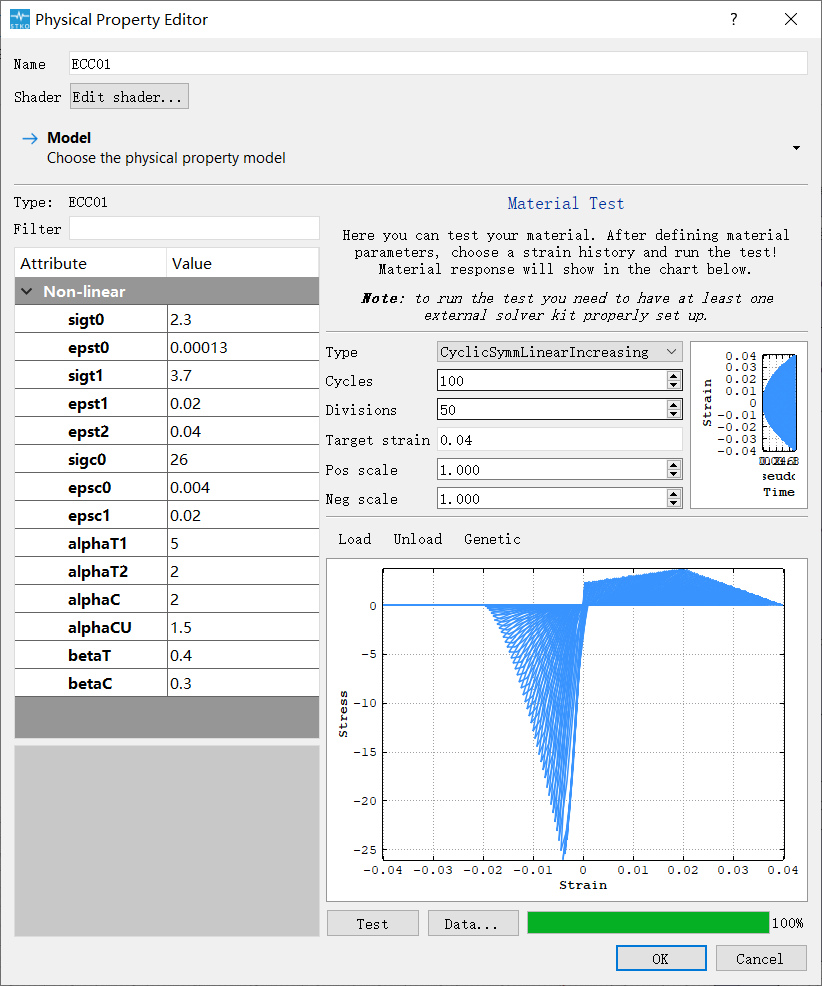
There is an uniaxial material named ECC01 in STKO, and I got the cyclic performance of ECC in the materials test interface as shown in picture by entering the relevant parameters. I verified the correctness of this constitution with a simple uniaxial model.
- 1.png (79.01 KiB) Viewed 1069 times
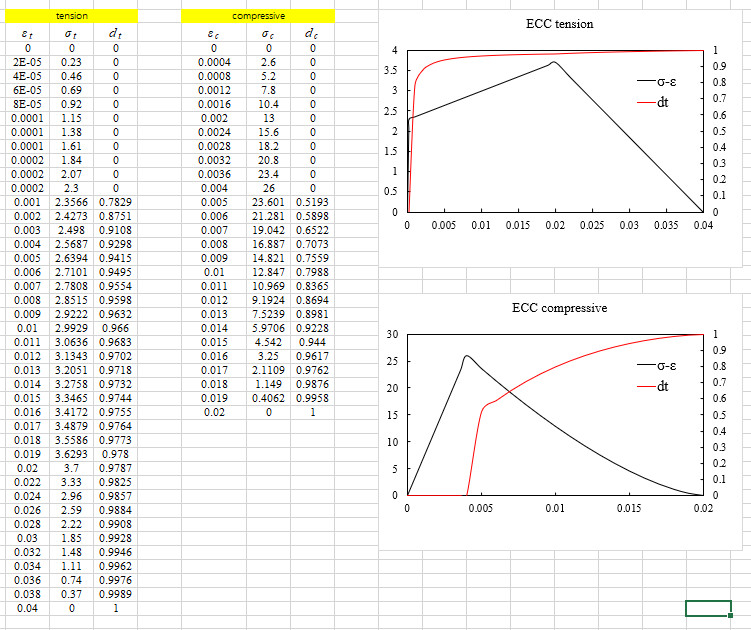
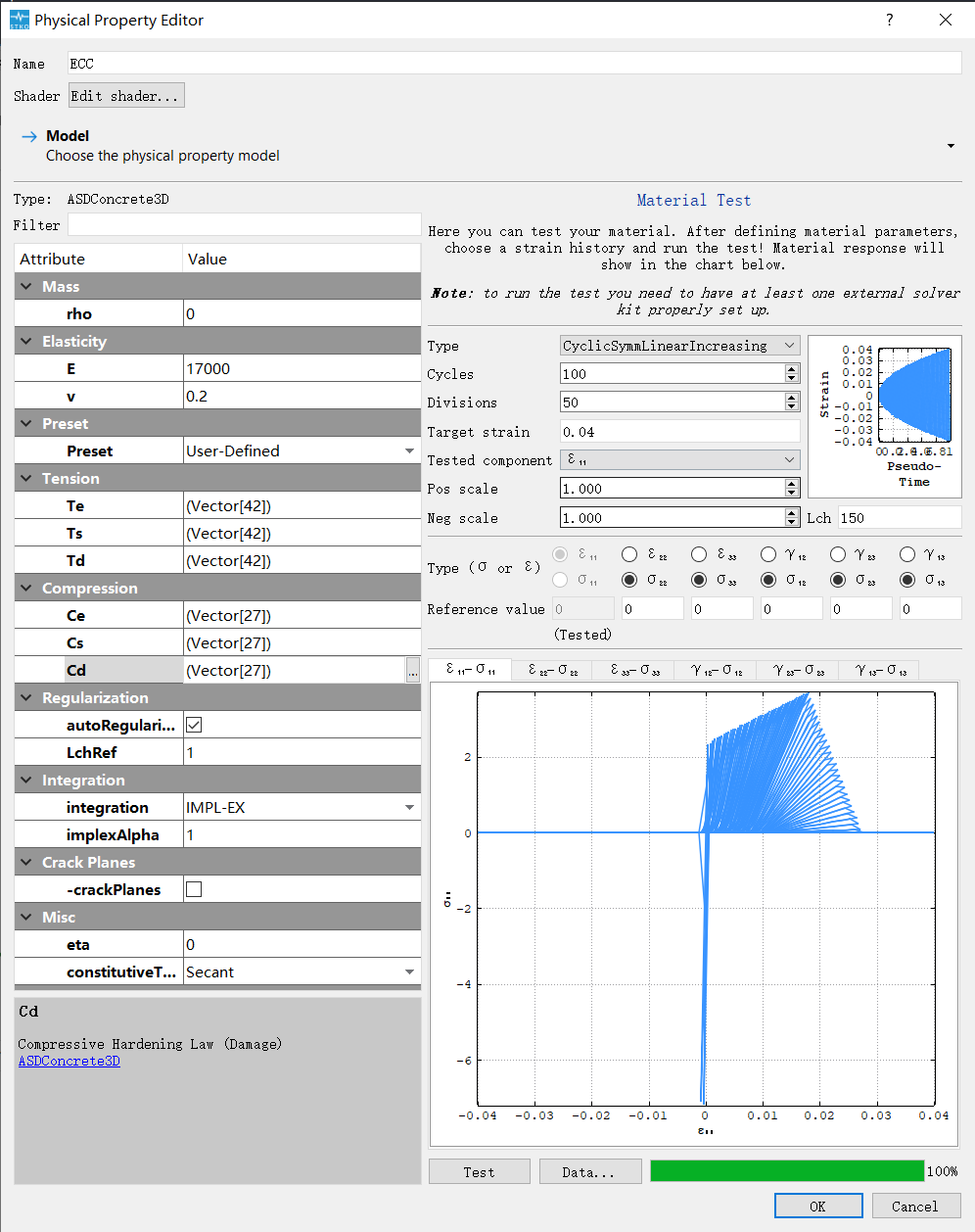
But I ran into some issues when I tried to use the ASDConcrete3D solid element constitutive to simulate ECC. When I enter the following stress, strain, and damage parameters, the materials test interface shows an incomprehensible cyclic curve.
- 2.png (65.23 KiB) Viewed 1069 times
- 3.png (106.38 KiB) Viewed 1069 times
I've tried reducing the damage value or even ignoring the damage at all, but it doesn't seem to work, and the hysteresis curve is still weird.
could you please Point out my mistakes and if possible help me debug a hysteresis effect like ECC01. Thanks a lot!
Re: About ASDConcrete3D User-defined
Posted: Mon Jul 29, 2024 2:16 pm
by STKO Team
You are on the right path, but there are some mistakes that the ASDConcrete3D tries to fix during runtime, that's why you don't see the expected results.
Make sure that at least the second_point - first_point (sigma-epsilon) of your curve gives the Young's modulus.
(sigma(1) - sigma(0)) / (eps(1) - eps(0)) = E
Try with few points and see what happens. In this stage don't care about plastic deformations. Set all damage variables to 1. Once you fix the backbone curves we will tell you how to properly compute the damage variables
Re: About ASDConcrete3D User-defined
Posted: Wed Aug 14, 2024 2:50 am
by haishui
STKO Team wrote: ↑Mon Jul 29, 2024 2:16 pm
You are on the right path, but there are some mistakes that the ASDConcrete3D tries to fix during runtime, that's why you don't see the expected results.
Make sure that at least the second_point - first_point (sigma-epsilon) of your curve gives the Young's modulus.
(sigma(1) - sigma(0)) / (eps(1) - eps(0)) = E
Try with few points and see what happens. In this stage don't care about plastic deformations. Set all damage variables to 1. Once you fix the backbone curves we will tell you how to properly compute the damage variables
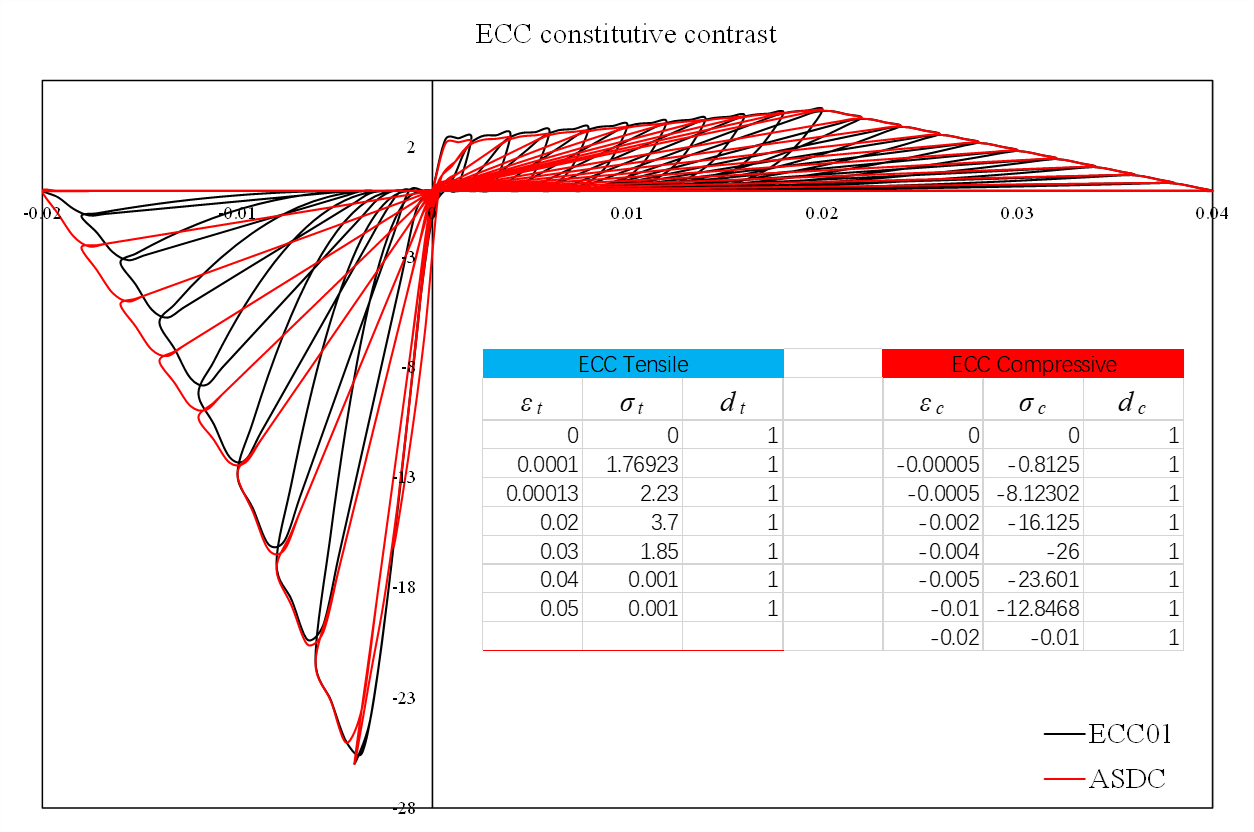
Thank you for the reply,I've adjusted the hysteresis curve to look like the one shown below as you requested.
- 3.png (143.25 KiB) Viewed 830 times
As you can see,the backbone curves have been fitted,but the unloading path of the hysteresis curve is a straight line through the origin with no residual deformation.
How do I think about the plastic deformation of ECC materials next?
Looking forward to your reply.
Re: About ASDConcrete3D User-defined
Posted: Mon Aug 26, 2024 2:53 pm
by STKO Team
As you can see,the backbone curves have been fitted,but the unloading path of the hysteresis curve is a straight line through the origin with no residual deformation.
Actually, as a starting point, this is good enough. Even if you cannot capture the plastic deformation, it's not a big issue (from a global point of view) because in this kind of material, permanent deformation are temporary: they are recovered upon load reversal:
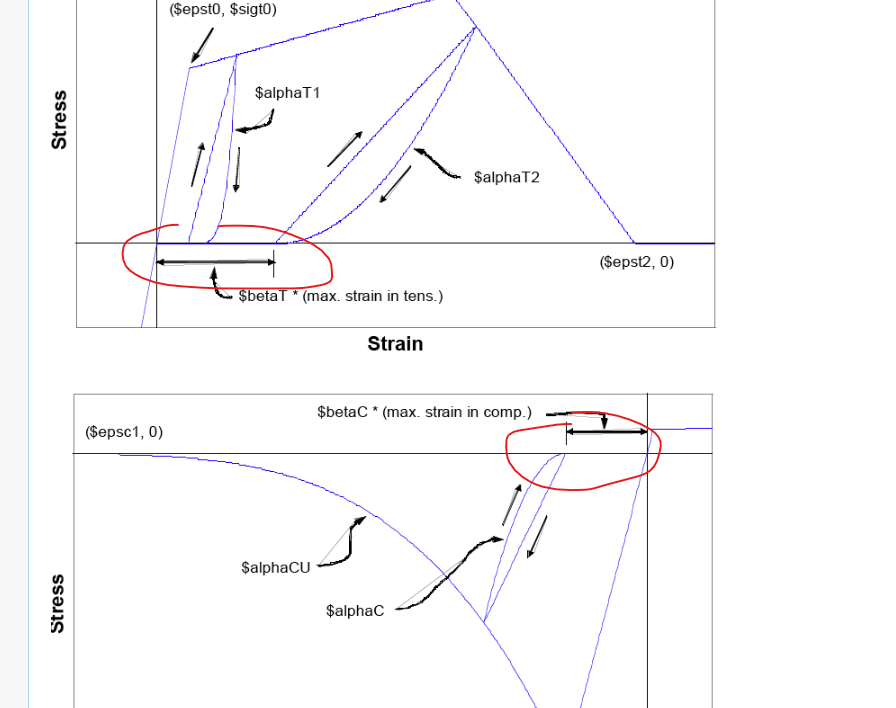
- recovered plastic deformations.png (80.78 KiB) Viewed 759 times
Currently, you cannot model this recovery of plastic deformation using a single 3D material. But you can do it by combining more materials:
- You can define a material for the compressive response with plastic deformation and strength only for the compressive part (and no strength and pure damage in tension):
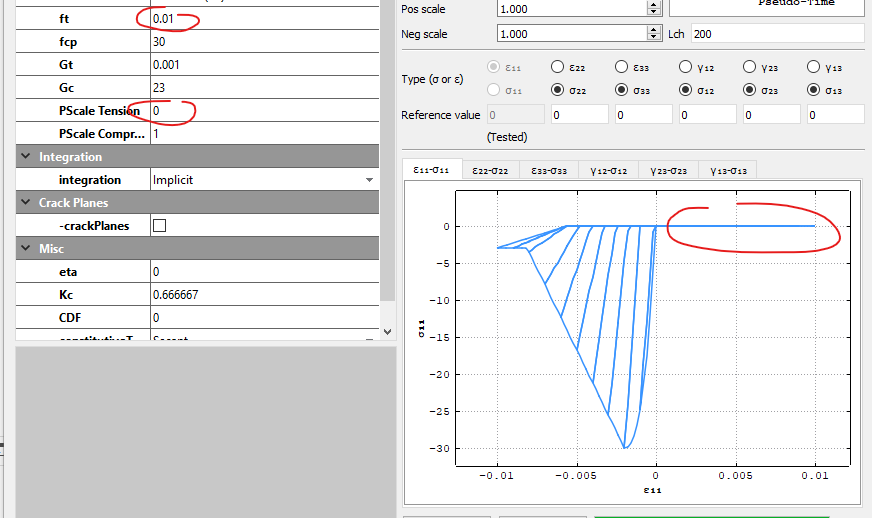
- pure_compression.png (46.19 KiB) Viewed 759 times
- Similarly for the tensile part only:
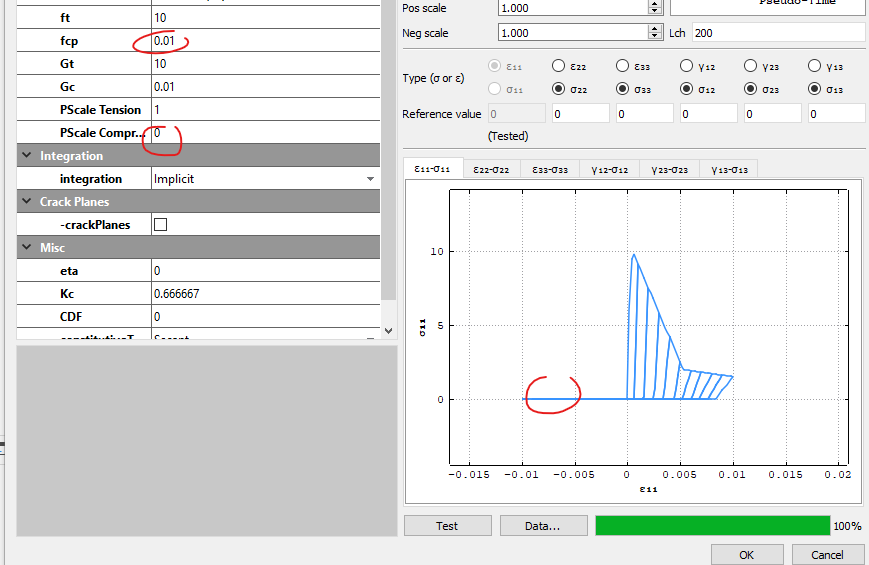
- pure_tension.png (38.76 KiB) Viewed 759 times
- Then you can combine them using the Parallel3D wrapper:
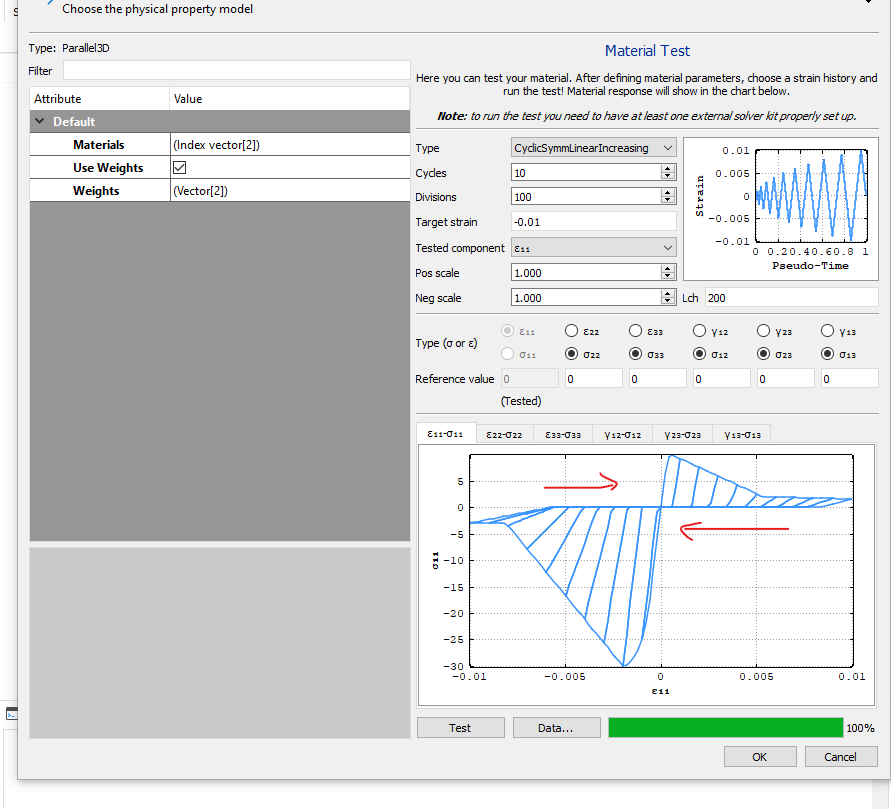
- parallel 3d.png (62.2 KiB) Viewed 759 times
Note: We recently added this new material wrapper (Parallel3D) to OpenSees repo. It will be available with the next version of STKO and OpenSees. Stay tuned, it will be released soon