Page 1 of 1

Unwanted oscillations in output

Posted: Sun Aug 07, 2022 3:32 pm
by Carlotta
Dear team STKO,
I built a model of a soil domain formed by a soil deposit on a bedrock layer (the geometry was built with Python API and then I did the merge operation).
As input, I used a Ricker Wavelet with dominant frequency 0.6 Hz and PGA 0.2 g: I considered an acceleration history at the free-surface (outcrop motion), I used deconvolution process to obtain bedrock motion and I applied the velocity-time history obtained from a deconvolution.

I ran the dynamic analysis and I had some problems with the results:
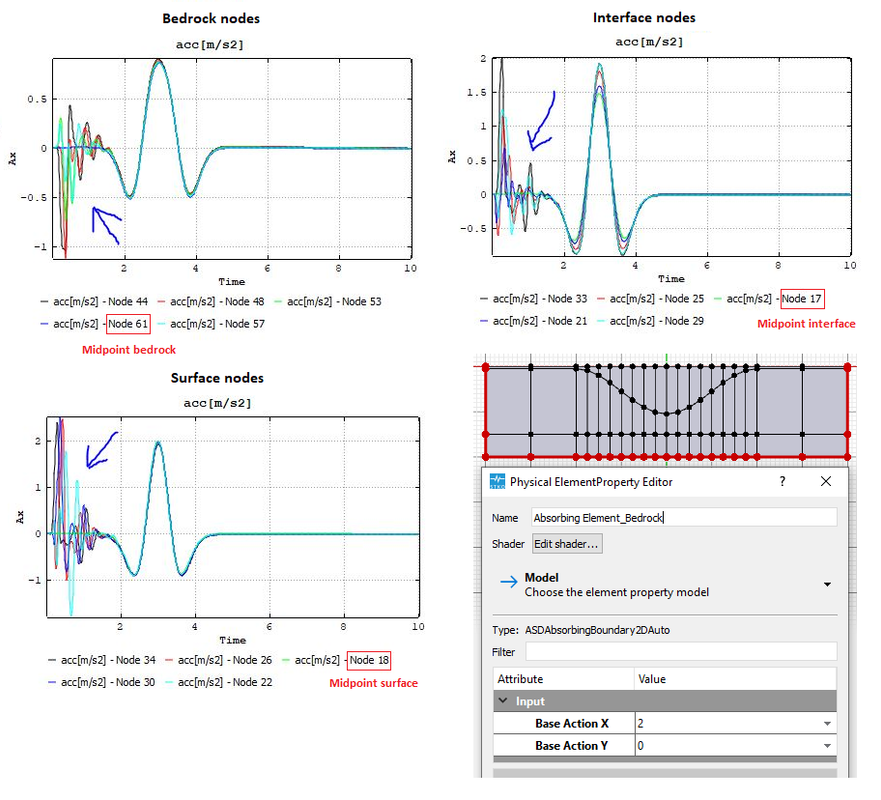
when I extract the results at the bedrock points (selection sets "bed_f_ .." ) I do not find the Ricker Wavelet used as input but there are unwanted oscillations in the firsts time steps, only at the midpoint of the model there are no oscillations; the same happens at the interface points and at the surface points.

I used Newmark integrator and I had done many tests changing gamma and beta values: if I increase these values, it seems that the fluctuations decrease but they are still present.

I don't understand whether it is a modelling problem or a problem in choosing AnalysesCommand's attributes.

The velocity-time history that I applied with the AbsorbingElement in the X direction is applied at the base of the model only or at the vertical elements also?
Image

Below I attached the files of the whole model and an excel file that I used to process the results.
Thank you in advance.
Re: Unwanted oscillations in output

Posted: Mon Aug 22, 2022 12:28 pm
by STKO Team
The problem was related to the initialStateAnalysis:

1) You forgot to assign the InitialState material wrappers -> In this way the model will "jump" back to its initial position without keeping the initial stress, so it will generate oscillations

2) When you use absorbing boundaries after you reset the displacement to 0 (initialStateAnalaysis OFF), you need an extra "dummy" analysis (either static or transient) just because the absorbing boundaries are not awere of the initialstate material wrapper, so you need an extra step where the displacement are reset to 0
FINe.png
FINe.png (139.77 KiB) Viewed 3390 times
Here's the modified file
2D_DY_B_06_02_L.zip
(277.32 KiB) Downloaded 254 times

Re: Unwanted oscillations in output

Posted: Thu Sep 08, 2022 5:23 pm
by Carlotta
Thank you for the reply!
I have one more question if you don't mind:
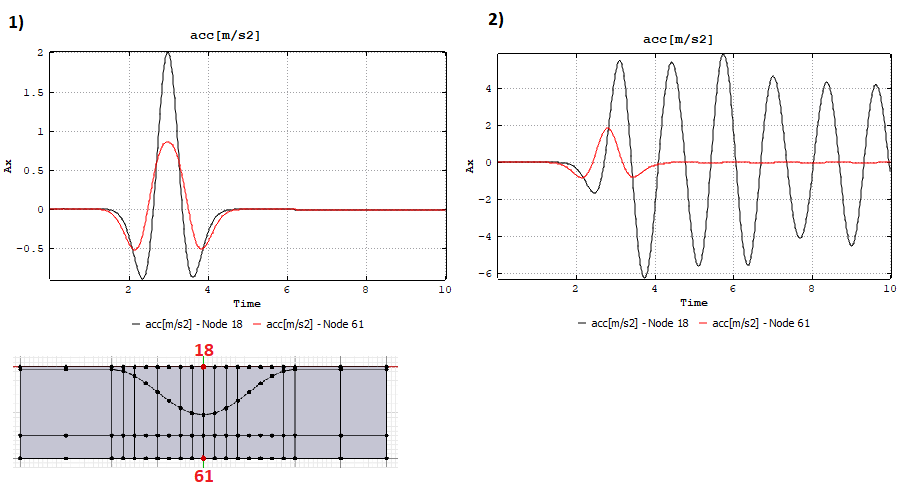
the results we get are the same as if there was only one layer of bedrock (1); I would have expected something different like what I get in the model I have attached below (2), where I changed the values of:
- Soil Elastic Modulus
- Bedrock Elastic Modulus
- Shear Modulus in Absorbing Boundary
(but these are not the values I should use).
Image

It seems that the first model does not feel the difference between the two layers.

Also, in the second model, I do not find the same ricker wavelet used as input in the base node (2_node 61).

How can I fix these results?
Thanks for your support.

Re: Unwanted oscillations in output

Posted: Fri Sep 09, 2022 11:12 am
by STKO Team
I don't fully understand your question.
However, in the file you sent me, you don't get the expected input at the base just because the bedrock domain is too small.

Given the material properties and the input frequency, the wavelength is about 6 km! you have to make the soil domain larger otherwise you will not be able to see the full wave entering the system:
wlen.png
wlen.png (49.14 KiB) Viewed 3350 times
Here's the file:
2D_DY_B_06_02_L.zip
(324.04 KiB) Downloaded 250 times

Re: Unwanted oscillations in output

Posted: Mon Sep 12, 2022 5:22 pm
by Carlotta
Thank you for your prompt reply!

So I could increase the depth of the bedrock or use a ricker wavelet with a shorter wavelength as input, is that right?
In STKO's pre processor is there the possibility to know what the input wavelength is, given the material properties and the input frequency? Or is it only visible in the post processor?

Thank you for all your assistance.

Re: Unwanted oscillations in output

Posted: Wed Sep 14, 2022 7:30 am
by STKO Team
So I could increase the depth of the bedrock or use a ricker wavelet with a shorter wavelength as input, is that right?
Yes
In STKO's pre processor is there the possibility to know what the input wavelength is, given the material properties and the input frequency? Or is it only visible in the post processor?
It's just
lambda = Vs/f(shear wave velocity over frequency of the input motion)

Then your maximum mesh size should be approximately lambda/8, in order to properly represent that displacement profile in your mesh...

Re: Unwanted oscillations in output

Posted: Wed Sep 14, 2022 5:33 pm
by Carlotta
Given the material properties and the input frequency, the wavelength is about 6 km!
If the shear wave velocity of the bedrock is 800 m/s and the frequency of the input motion is 0,6 Hz (I have to use the peak frequency, don't I?) lambda should be about 1,3 km , isn't it?

Thanks for your patience.

Re: Unwanted oscillations in output

Posted: Thu Sep 15, 2022 8:02 am
by STKO Team
If the shear wave velocity of the bedrock is 800 m/s and the frequency of the input motion is 0,6 Hz (I have to use the peak frequency, don't I?) lambda should be about 1,3 km , isn't it?
imagine your input has typical frequencies in the range fmin-fmax
I would use fmax to compute the maximum allowable mesh size:
mesh_size_max = Vs/fmax/8 (in fact it gives the minimum value for the mesh size)

and fmin for computing the largest wavelength that can enter in your domain. However this is aspect is less important. I told you this just because you are doing a benchmark with a wavelength that has 1 main frequency. But with a real record it might be difficult