Page 1 of 1
Interface Between Soil & Pile
Posted: Sat Apr 25, 2020 9:21 pm
by vokumus
Hi everyone;
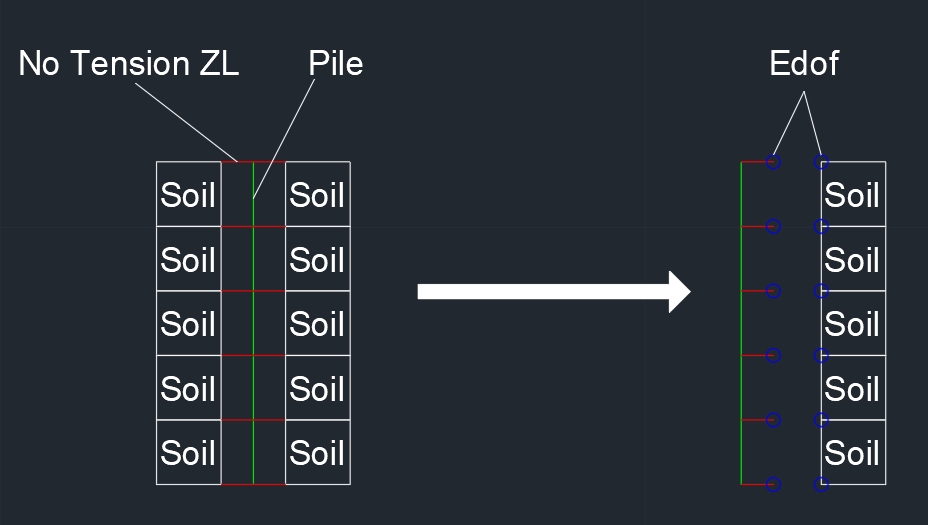
I am trying to create 2D and 3D SSI models and I want to model piles. A drawing is attached which explains my model briefly. There is a NL pile element, zero length (with no tension material) interface elements connects pile to soil. I guess I have to add EDOFs between soil and my ZL elements since their DOFs are different.
Question is, I don't want to model this one by one for each node in my model. What is the fastest way to achieve this?
Thanks in advance.
- 2020-04-26 00_08_40-Window.jpg (90.04 KiB) Viewed 5525 times
Re: Interface Between Soil & Pile
Posted: Mon Apr 27, 2020 8:41 am
by STKO Team
Dear user,
our implementation of the zeroLength element in STKO already handles this situation. If the DOFS between the zeroLength and the attached elements (beams on one side, and soil in the other side) are different, the STKO script automatically creates duplicated nodes with the same dofs of the zeroLength, and the common dofs are linked with Equal Dof constraint.
Assume this case:
2D problem:
Pile = beam, 3 dofs (Ux, Uy, Rz)
Soil = quadUP, 3 dofs (Ux, Uy, P)
zeroLength material = 2D, U = 2 Dofs (Ux, Uy)
zeroLength element = 2D
The zeroLength element/material are assigned to an interaction.
Then if you look at the code generated in elements.tcl you will see that we automatically create extra 2-Dofs nodes for the zeroLength elements, at the same location of the source counterparts (Pile and/or soil). Then the common dofs (Ux, Uy) are constrained with EDOF.
Let us know
Re: Interface Between Soil & Pile
Posted: Thu Apr 30, 2020 6:05 am
by vokumus
That's awesome. Thanks.
Re: Interface Between Soil & Pile
Posted: Thu May 07, 2020 8:19 pm
by vokumus
Hi;
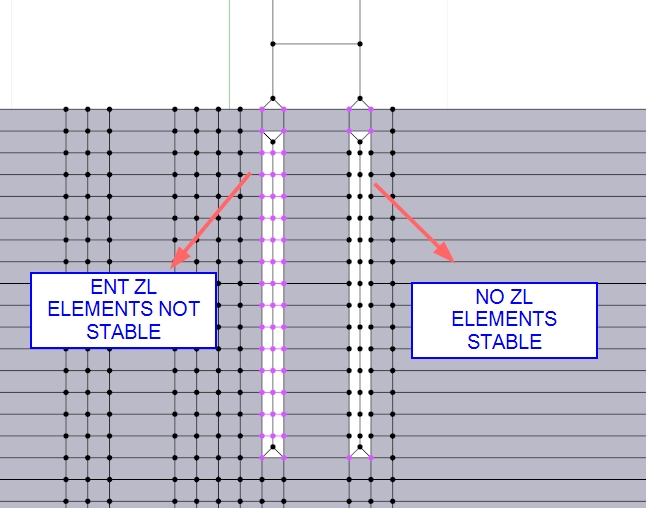
I am trying to make a simple soil-pile model. I want to connect my piles to soil with ZL elements which has Elastic No Tension material. But when I do this, system becomes unstable and OpenSees gives an error. When I remove those ZL elements, system becomes stable again. There is a picture which explains my model. Do you have any idea what could be the problem?
Thanks.
Update: When I changed constraints type from transformation to penalty method dynamic analysis started but solution didn't converge after a couple of steps.
Update 2: I saw this example this morning.
https://opensees.berkeley.edu/wiki/inde ... ifuge_Test
They used parallel material which consists of an ENT and a dummy material with a very small elastic modulus. I have applied that method to my model. I have changed constraints back to transformation and I have choosen algorith as Newton and finally problem is solved.
Please share if you have any other solution for this.
- 2020-05-07 23_09_47-Window.jpg (126.54 KiB) Viewed 5428 times
Re: Interface Between Soil & Pile
Posted: Fri May 08, 2020 10:24 am
by STKO Team
Dear user,
It make sense that the ENT materials may give convergence issue... however I have one question. When using the penalty method, did you make sure that the test command is not one of those who check the Unbalance? Note that when you use Penalty you should always use a test that checks displacement norm.
If you share your SCD file here I will have a look
Re: Interface Between Soil & Pile
Posted: Fri May 08, 2020 11:26 am
by vokumus
As soon as I remember, I have never used unbalance. I have changed my model a little bit, it seems it works fine now. But when you select Krylov, modified newton etc.. it has convergence issues. Only Newton works well.
I have two more questions:
1. When you specify a "rho" value in pressureIndepentMaterial, does "rho" value accounts the elements self mass in dynamic analysis?
2. When I specify mass for my piles (elastic material, giving Rayleigh damping too) there are high acceleration and displacement values in soil. What could be the reason of that?
My model is attached. Thank you very much.
Re: Interface Between Soil & Pile
Posted: Mon May 11, 2020 9:55 am
by STKO Team
But when you select Krylov, modified newton etc.. it has convergence issues. Only Newton works well
This can happen. Newton is the most general one. Sometimes, for some kind of nonlinear problems, the others works better, but this is not a rule. Keep in mind however that the others are modified newton methods... so they do not have a quadratic convergence rate, so typically you would need more iterations to achieve convergence...
When you specify a "rho" value in pressureIndepentMaterial, does "rho" value accounts the elements self mass in dynamic analysis?
It should be like this. In OpenSees code the rule is: The element looks for the rho in its materials. If the rho in the materials is zero, then it uses its own rho (some elements have this option).
When I specify mass for my piles (elastic material, giving Rayleigh damping too) there are high acceleration and displacement values in soil. What could be the reason of that?
This looks strange. I will need to have a look at your file...