Page 2 of 2
Re: Modeling with ASDEmbeddedNodeElement
Posted: Tue Apr 16, 2024 10:50 am
by polatd
I'll be happy if you can help me
Re: Modeling with ASDEmbeddedNodeElement
Posted: Wed Apr 17, 2024 12:50 pm
by polatd
Hi STKO team,
I solve convergance problem
but now I don't know how to visualize the masonry wall or cracking pattern.
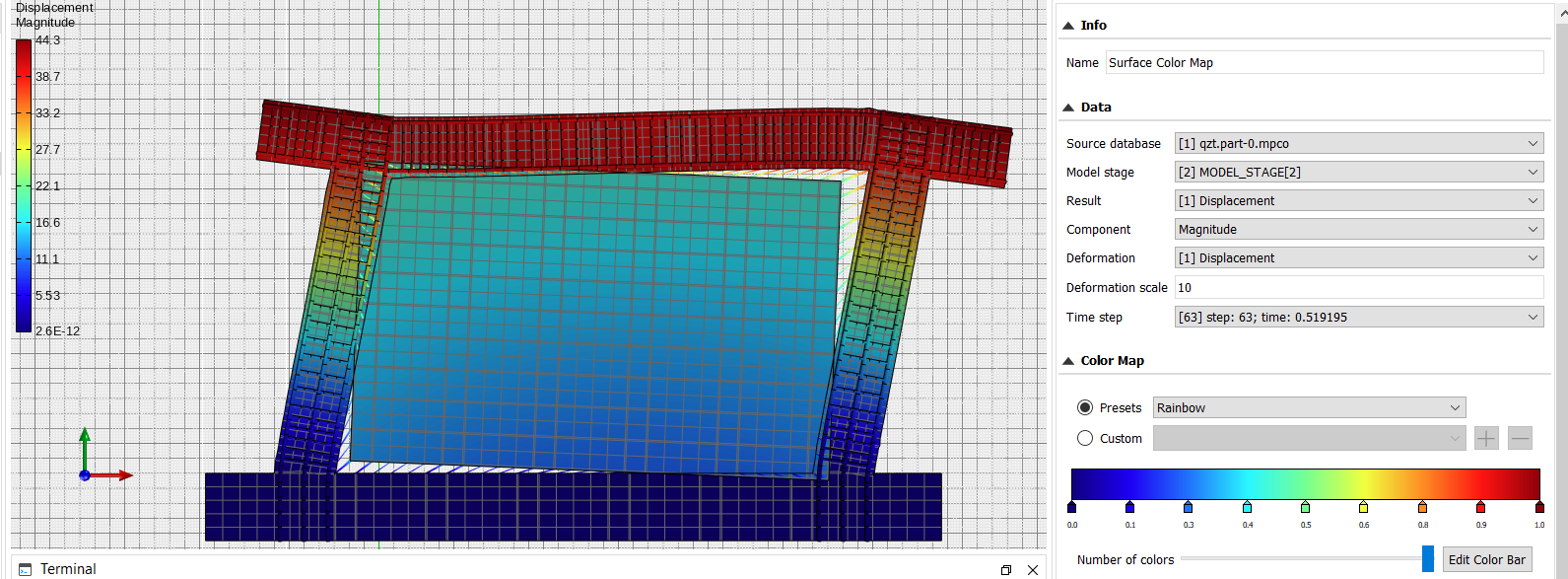
and also I have problem like in the figure,
The connection between the concrete and the infill wall does not seem to be working properly.
How can we operate this connection appropriately
- infill.PNG (420.16 KiB) Viewed 3970 times
Thanks.
Re: Modeling with ASDEmbeddedNodeElement
Posted: Wed Apr 17, 2024 1:10 pm
by kesavapraba
Hi, It is because you have created the interaction between the masonry infill and the RC elements, however, no conditions (for example, EDOF) has been assigned to the interactions. Please make sure the interaction has appropriate conditions.
To visualize the crack/crush pattern, damage parameters (d+ crack and d- crush) in Gauss plot can be useful. Please remember that the damage parameters come from the DamageTC3D material model.
Re: Modeling with ASDEmbeddedNodeElement
Posted: Thu Apr 18, 2024 8:09 am
by STKO Team
It's because your local axes for contact are wrong.
In 3D it's the local Z axis that should go from master to slave
Re: Modeling with ASDEmbeddedNodeElement
Posted: Thu Apr 18, 2024 3:59 pm
by polatd
Thanks for your help,
I assigned the local axes to be the z direction in 3D, as you said.
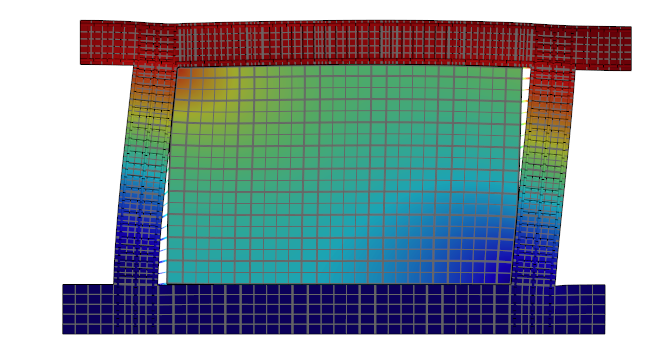
But I couldn't understand why the connection between the infill wall and the concrete did not match. (like in the figure)
I saw in previous studies on the forum that no condition was assigned between the infill wall and the concrete.
How should I assign the Condition you mentioned?
Re: Modeling with ASDEmbeddedNodeElement
Posted: Fri Apr 19, 2024 10:49 am
by STKO Team
The problem now is not the contact. If you look carefully you will see that the mortar layer near the frame is crushing.
Just use smaller time steps.
80 mm in 100 steps is 0.8 mm per step.
0.8 mm is 8% of the mortar thickness (10 mm), so the instantaneous compressive strain in the very first iteration is almost 0.08 !!! way after the crushing of mortar!
Keep in mind that everytime you have softening, it's very important to use small time steps. At least small enough not to induce huge strains (higher than the peak) instantaneously.
- INFILL.png (178.46 KiB) Viewed 3952 times