Nothing to regenerate

amb_1
Posts: 63
Joined: Wed Jun 08, 2022 11:32 am

Nothing to regenerate

Post by amb_1 » Thu Nov 17, 2022 6:00 am

Dear STKO Team
I am very sorry that I have met a problem and need your help. When I used STKO software, my software occasionally appeared to blink back, and when I opened it again, there was nothing. I have encountered the same situation 5 times when I was simulation different experiment. I spent a week on one model, but I have nothing. Can you help me? I have been a bit alarmed about this situation because I need to constantly adjust the model, but I can't save different versions all the time dear SKTO team.
Best wishes
Image
Attachments
wwww.jpg
wwww.jpg (190.28 KiB) Viewed 6273 times
jiazhou.rar
(1.85 MiB) Downloaded 182 times
微信图片_20221117135707.jpg
微信图片_20221117135707.jpg (14.84 KiB) Viewed 6274 times

STKO Team
Posts: 3069
Joined: Tue Oct 29, 2019 8:45 am

Re: Nothing to regenerate

Post by STKO Team » Thu Nov 17, 2022 11:08 am

It's because you have some inconsistencies in your file.
There is a selection set that is referencing an interaction (ID = 8) that does not exist in your model. I found it reading the error (RED) message in the terminal.
Then I opened the file in the (free tool) HDFView:
error.png
error.png (44.42 KiB) Viewed 6270 times

How did it happen? Did you make this file using a Python script? Probably there was a mistake in the script.
Anyway, using HDFView I managed to change that INTERACTIONS Dataset to have only the ID = [7], instead of [7, 8].

Here's the modified file:
jiazhou.zip
(2.79 MiB) Downloaded 188 times

amb_1
Posts: 63
Joined: Wed Jun 08, 2022 11:32 am

Re: Nothing to regenerate

Post by amb_1 » Fri Nov 18, 2022 6:22 pm

Dear STKO Team
I'm sorry that I encountered the same problem again. My other model crashed. I want to know how you solved this problem. Can you teach me? When I open it with HDFView software, an error is displayed. My model was built with STKO software, not Python. When I consulted my colleagues around me, they also encountered this devastating problem.
Best wishes
Attachments
jiazhou20221118.rar
(1.12 MiB) Downloaded 189 times
微信图片_20221119022048.png
微信图片_20221119022048.png (156.07 KiB) Viewed 6256 times
微信图片_20221119022004.png
微信图片_20221119022004.png (22.8 KiB) Viewed 6256 times

STKO Team
Posts: 3069
Joined: Tue Oct 29, 2019 8:45 am

Re: Nothing to regenerate

Post by STKO Team » Mon Nov 21, 2022 9:23 am

I'm sorry but the problem with this file is different. It says it is corrupted and cannot be opened.
Do you know when the crash happened?
Can you reproduce it on another file so that I can debug it?

amb_1
Posts: 63
Joined: Wed Jun 08, 2022 11:32 am

Re: Nothing to regenerate

Post by amb_1 » Tue Nov 22, 2022 2:53 am

Dear Team STKO
I'm sorry, many crashed files have been deleted, but I often encounter. I have a question about boundary conditions.
I did a centrifuge test on a saturated soil slope site (similar to the case on STKO website), using a shear box. I encountered some problems about the boundary. When I used the energy boundary calculation provided by the website, it often failed to converge(When counting strong-earthquakes liquefaction). Regarding the slope site (PDMY02) boundary, do you have any good suggestions in this regard? Do you have any good suggestions about this? I have been puzzled about this problem for a long time, and I have been unable to find a good solution to deal with it
Attachments
boundary.rar
(2.04 MiB) Downloaded 190 times
图片1.png
图片1.png (44.79 KiB) Viewed 6212 times
图片2.png
图片2.png (67.07 KiB) Viewed 6212 times
图片3.png
图片3.png (260.75 KiB) Viewed 6212 times

STKO Team
Posts: 3069
Joined: Tue Oct 29, 2019 8:45 am

Re: Nothing to regenerate

Post by STKO Team » Tue Nov 22, 2022 9:21 am

I think none of those approaches are correct.
I understood that you are simulating a centrifuge test, so you should replicate those boundary conditions.
Free field or absorbing boundaries are not correct.
Typically they use periodic conditions for centrifuge tests. But it might be a problem for slopes.

I tried to modify the first model, because the EDOF should be added from the beginning. Otherwise the columns are detached from the soil.
I also corrected few other settings. The newmark parameters were strange and I experienced some instabilities.
Now it seems to work, but it has convergence issues as soon as you start plastic analsys.
Please check the settings to make sure it is what you want to do
Attachments
model_3d_basic_PDMY_01_changonoff.zip
(910.71 KiB) Downloaded 186 times

amb_1
Posts: 63
Joined: Wed Jun 08, 2022 11:32 am

Re: Nothing to regenerate

Post by amb_1 » Tue Nov 22, 2022 4:52 pm

Dear STKO
I know the reason why convergence is not possible. I often encounter this problem when using STKO, and I have solved it. It is very sensitive for grid size, all grids must be in the same size. Strangely, however, I do not see this problem when using the grid provided by other meshes software (GID, Hypermeh, abaqus). This is a strange phenomenon, as the last time I provided the grid provided by OPenSeesPL, it works regardless of the mesh deformity. I guess it is related to the grid partition of parallel computing. In other software, I used vertical partition, but I do not know how to realize the partition of STKO parallel grid computing.
Sorry, my theoretical basis is not very good. The reason why newmark sets parameters 1.5 and 1.0 is that I have seen from the literature that gravity balance recommends the selection of parameters. I have derived the calculation formula of newmark.
My models are all inclined, and the boundary has a great impact on my settlement results. The conventional shear beam boundary cannot be used. There are too many models to upload completely. I have provided an elastic model.

I'm sorry for I might have a little too many questions:

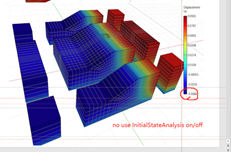
1, about InitialStateAnalysisWrapper, in the dynamic analysis of gravity balance simulation, some cases using (InitialStateAnalysis on/off), in some cases there is no use InitialStateAnalysis on/off), In opensees website (https://opensees.berkeley.edu/wiki/inde ... s_of_Slope) and OPenSesPL website (https://www.baidu.com/link?url=7Z2pPZDR ... 03637cedb9), however, according to the comparison of my simulation results, I found that sometimes the two results are similar, and sometimes they are quite different. Could you please tell me whether they are used in dynamic analysis?
1.png
1.png (80.28 KiB) Viewed 6202 times
2.png
2.png (56.21 KiB) Viewed 6202 times

2. In addition, I also encountered a problem that sometimes had a big impact on the results, and sometimes had a small impact. When the volume modulus and shear modulus are updated to large values in gravity equilibrium, to prevent large deformation (the principle is similar to that in the More-Coulomb constitutive simulation of FLac3D), and then updated to normal values before dynamic simulation, do you think I should use the updated volume modulus and shear modulus when using PDMY02 simulation?

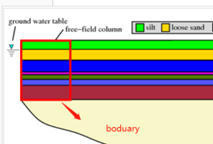
3. According to the centrifuge test, should my boundary adopt the following scheme (1) or(2)?
3.png
3.png (135.35 KiB) Viewed 6202 times
4.png
4.png (129.74 KiB) Viewed 6202 times
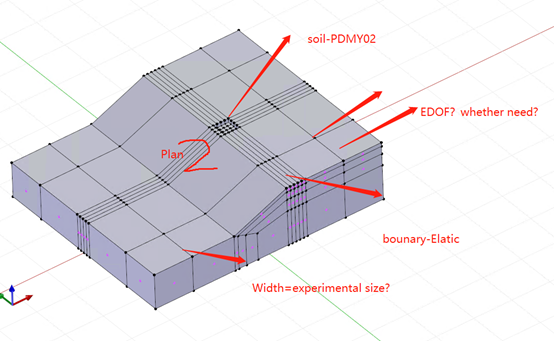
4, I want to know my model the boundary of the material whether to adopt and shear box in the experiments of the same material (elastic) (HTTP: / / https://www.researchgate.net/publicatio ... Pile_Group _response_subjected_TO_induced_large_ground_deformation_in_e-defense_shake_table_test), or PDMY02 (the same as below)? However, my model does not work, can you help me to look at it?
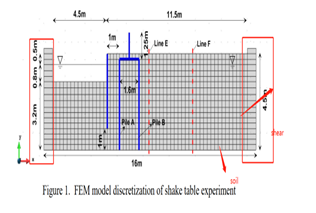
5.png
5.png (49.06 KiB) Viewed 6202 times
6.png
6.png (8.73 KiB) Viewed 6202 times
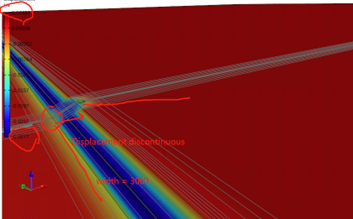
5. Should the width of the model box be the same as that of the test shear box? However, based on my recent research, I found that width has a huge impact on the results,

6. Opensees website provides a case study on how to simulate a real field, using free field boundaries, Boundary using PDMY02, it has a value of 10000 (https://opensees.berkeley.edu/wiki/inde ... s_of_Slope), However, when I use different lengths in 3D to simulate the 3D is free field, the results of the model are very large due to different scales, and the impact on the results is very large. Could you please give me a suggestion on the range of values?
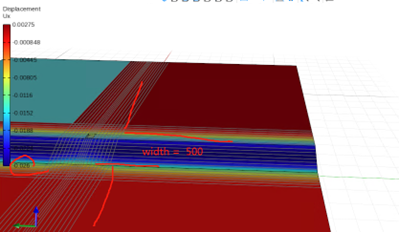
7.png
7.png (101.73 KiB) Viewed 6202 times
8.png
8.png (131.29 KiB) Viewed 6202 times
9.png
9.png (88.19 KiB) Viewed 6202 times
7. Could you please tell me the development of the elastoplastic energy absorption boundary (PDMY) version, when the lecture will be held? When is the update in new STKO version?

8. STKO is the best software I have ever encountered in learning openses. Regarding the use of STKO software, does the company have a separate software training camp? In addition, can we invite your company to carry out training and lectures?

Best wishes
Attachments
model_3d_basic_PDMY_01_changonoff_elsatic.rar
(493.3 KiB) Downloaded 183 times
4.png
4.png (129.74 KiB) Viewed 6202 times
3.png
3.png (135.35 KiB) Viewed 6202 times

STKO Team
Posts: 3069
Joined: Tue Oct 29, 2019 8:45 am

Re: Nothing to regenerate

Post by STKO Team » Wed Nov 23, 2022 8:55 am

I know the reason why convergence is not possible. I often encounter this problem when using STKO, and I have solved it. It is very sensitive for grid size, all grids must be in the same size.
Mesh distortion can have an impact on the accuracy of the analysis, but this is true for every FEM solver.


Strangely, however, I do not see this problem when using the grid provided by other meshes software (GID, Hypermeh, abaqus). This is a strange phenomenon, as the last time I provided the grid provided by OPenSeesPL, it works regardless of the mesh deformity. I guess it is related to the grid partition of parallel computing. In other software, I used vertical partition, but I do not know how to realize the partition of STKO parallel grid computing.
If the issue is related to the partition, then there can be a bug in the material model.
The partitioning scheme should only affect the efficiency of parallel computing, not the results.
We have recently found a similar issue in the PDMY03 material and we made a Pull Request here:
https://github.com/OpenSees/OpenSees/pull/1054


1, about InitialStateAnalysisWrapper, in the dynamic analysis of gravity balance simulation, some cases using (InitialStateAnalysis on/off), in some cases there is no use InitialStateAnalysis on/off), In opensees website (https://opensees.berkeley.edu/wiki/inde ... s_of_Slope) and OPenSesPL website (https://www.baidu.com/link?url=7Z2pPZDR ... 03637cedb9), however, according to the comparison of my simulation results, I found that sometimes the two results are similar, and sometimes they are quite different. Could you please tell me whether they are used in dynamic analysis?
As stated in the documentation, using the InitialStateAnalysisWrapper can create unwanted oscillations in transient analyses. It can be solved using a dummy slow analysis without any laod after the OFF command. But if you don't need to put a frame or shell structure on the soil domain, you don't really need the initial state wrapper at all.


2. In addition, I also encountered a problem that sometimes had a big impact on the results, and sometimes had a small impact. When the volume modulus and shear modulus are updated to large values in gravity equilibrium, to prevent large deformation (the principle is similar to that in the More-Coulomb constitutive simulation of FLac3D), and then updated to normal values before dynamic simulation, do you think I should use the updated volume modulus and shear modulus when using PDMY02 simulation?
It's just a trick FLAC is using. I would not use the same approach in OpenSees. FALC does it, but probably it also does something to avoid that the sudden change in the elastic properties create issues in dyanamic analyses...


3. According to the centrifuge test, should my boundary adopt the following scheme (1) or(2)?
I think that none of the two are representative of the centrifuge test conditions imposed by the box.
Why don't you try to model the real setup?
For example, you can model the steel box, and the material between the steel box and the soil (I've seen that sometimes they use materials to minimize wave reflections)

5. Should the width of the model box be the same as that of the test shear box? However, based on my recent research, I found that width has a huge impact on the results,
What is stated in opensees website about using a Thicker column, is to simulate the free field, which is not applicable to your example.
Yours is a centrifuge test.


7. Could you please tell me the development of the elastoplastic energy absorption boundary (PDMY) version, when the lecture will be held? When is the update in new STKO version?
We are still working on extending the ASDAbsorbingBoundaryElement with nonlinear materials.
However now OpenSees has a new tool for something similar, which is called DRM, and we are going to do a webinar on this on the 15th of December! Don't miss it.


8. STKO is the best software I have ever encountered in learning openses. Regarding the use of STKO software, does the company have a separate software training camp? In addition, can we invite your company to carry out training and lectures?
Please contact [email protected]

amb_1
Posts: 63
Joined: Wed Jun 08, 2022 11:32 am

Re: Nothing to regenerate

Post by amb_1 » Wed Nov 23, 2022 11:12 am

Dear STKO Team
Thank you for your answer. I have tried to use the same material as the test shear box for the boundary (some articles) last year. When the boundary material is PDMY or PDMY and other materials similar to soil, the model can work normally. However, in any case, when the boundary material is elastic (shear box), the model cannot work. This problem has puzzled me all the time. I have consulted some researchers, However, everyone failed to achieve it. At present, our team is trying to use the same boundary as the test, but strangely, when I added a new material (elastic) similar to the test (shear box) on the soil boundary, the model could not be running. At present, I am looking for the reason. So the attachment I provided for your free field is made of elastic material (model_3d_basic_PDMY_01_changonoff_elsatic. rar). I want to know where my problem is, because it can't be solved all the time.


I'm looking forward to your 15th of December's lecture. I'd like to know whether DRM refers to DRM on website( https://opensees.github.io/OpenSeesDocu ... H5DRM.html )。

I have reported the lecture to the team leader and will contact by email.

Best wishes

STKO Team
Posts: 3069
Joined: Tue Oct 29, 2019 8:45 am

Re: Nothing to regenerate

Post by STKO Team » Thu Nov 24, 2022 8:02 am

Can you show a sketch of the experimental test setup? Probably the free-field model is not the right one
I'm looking forward to your 15th of December's lecture. I'd like to know whether DRM refers to DRM on website
Yes it is

Post Reply